


Archival storage of documents and photographs: acid-free, lignin-free, buffered, PAT – what they mean and what to choose

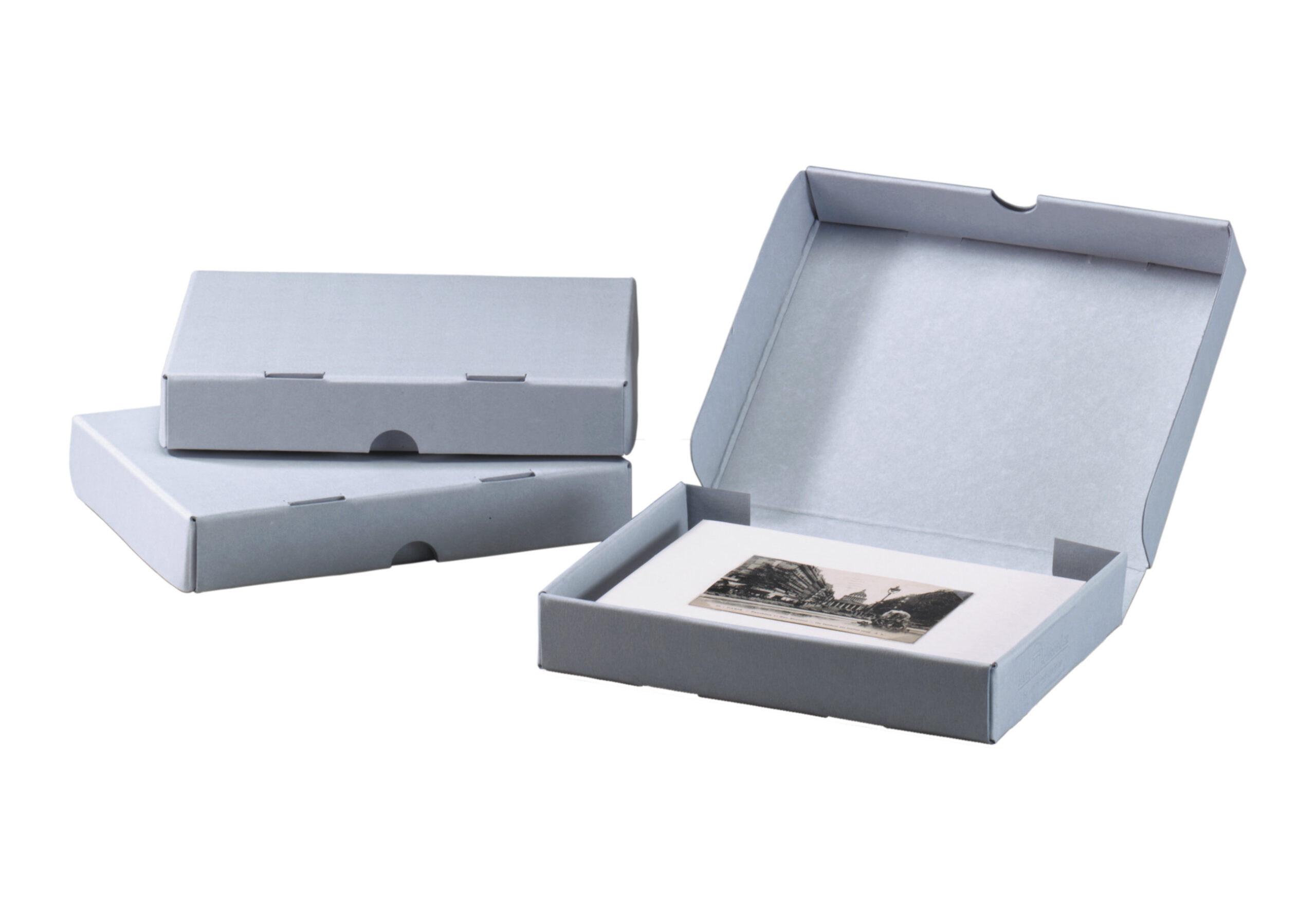
Correct storage is the most effective – and the most economical – form of preventive conservation for archives, libraries and photographic collections. A document in an unsuitable folder or a photograph in a PVC plastic sleeve can suffer damage within a few years that no treatment can fully reverse. Yet many terms are used on the market – acid-free, lignin-free, buffered, unbuffered, PAT, ISO 9706 – which are often used loosely. In this guide we explain what each one means, which standards apply and how we choose materials for documents, books and photographs.
Why paper deteriorates
Paper consists mainly of cellulose. Its main chemical deterioration is acid hydrolysis: acids break the cellulose chains, the paper yellows, becomes brittle and eventually crumbles. Acids come from the paper itself (e.g. alum-rosin sizing in 19th- and 20th-century paper), from the lignin in wood pulp, from atmospheric pollution and from storage materials in contact with the document. The oxidation and photochemical deterioration accelerate the process, while high temperature and relative humidity multiply the rate of the reactions.
Storage materials therefore have two aims: to do not add harmful substances to the object and, where necessary, to protect it from external factors (dust, light, pollutants, mechanical stress, sudden changes in humidity).
The terms, one by one
Acid-free
Paper or board with a neutral or slightly alkaline pH (usually pH 7 or higher) at the time of manufacture. Note: the term describes the condition at the time of manufacture. An acid-free paper containing lignin can become acidic over time. That is why the term "acid-free" on its own is not enough for archival use.
Lignin-free
Lignin is a natural polymer of wood that oxidises and produces acids and chromophores – it is the reason newsprint turns yellow. Archival papers are made from pure chemical cellulose pulp (alpha-cellulose) or cotton (rag), with a minimal lignin content. ISO 9706 controls lignin indirectly via the kappa number (less than 5).
Buffered (with alkaline reserve)
Paper to which has been added alkaline reserve, usually calcium carbonate (CaCO₃) or magnesium carbonate. The reserve neutralises acids that will form in future or migrate from the environment or from neighbouring acidic documents. According to ISO 9706, the alkaline reserve must correspond to at least 0.4 mol/kg (about 2% calcium carbonate), with an extract pH between 7.5 and 10. Buffered materials are the general recommendation for most paper documents, especially acidic 19th–20th-century papers.
Unbuffered
Acid-free and lignin-free paper with neutral pH, but without alkaline reserve. It is recommended for materials that may be affected by alkalinity: certain historical photographic processes (e.g. cyanotypes, albumen prints), certain colour photographs with dyes, and protein materials such as wool, silk, leather and parchment. In mixed photographic collections, many institutions prefer unbuffered materials that have passed the PAT as the safer general choice.
PAT – Photographic Activity Test
PAT is an international test standard (ISO 18916) developed by the Image Permanence Institute. It checks whether a storage material (paper, board, plastic, adhesive, ink, label) causes chemical reactions with photographic materials – specifically, whether it causes image fading or gelatine staining. A material that "passes the PAT" is suitable for direct contact with photographs. The PAT not is it an indicator of mechanical strength, nor does it replace the requirements for pH or lignin; it is a complementary criterion. The relevant standard for enclosures for photographic materials is ISO 18902.
Archival paper to ISO 9706 / ISO 11108
The ISO 9706 sets out the requirements for "permanent paper": alkaline reserve, pH, low lignin and minimum tear resistance. The ISO 11108 (archival paper) adds requirements for high folding endurance, suitable for documents in very frequent use. For boxes and folders for the archival storage of paper documents there is ISO 16245, while the requirements for storage areas are covered by ISO 11799 and the EN 16893.
Plastics for archival use
Transparent enclosures allow examination without handling, but only certain plastics are suitable:
- Polyester (PET, known by trade names such as Melinex or Mylar): chemically stable, transparent, rigid. The first choice for sleeves for documents, maps and photographs. Note: it builds up static electricity, so it not is recommended for friable media (charcoal, pastel, chalk) or flaking paint.
- Uncoated polypropylene (PP) and polyethylene (PE): stable and cheaper, suitable for photograph and negative sleeves when they have passed the PAT.
- Avoid PVC ("vinyl") and soft plastics with plasticisers: they release acidic and oily products that damage photographs and inks.
How to choose: a practical guide
- Record the material: type (document, map, photograph, negative, glass plate), photographic process if known, size, condition, frequency of use.
- Paper documents, books: buffered folders and boxes to ISO 9706/16245. Acidic documents (e.g. newspapers, cuttings) are separated from the rest with a buffered interleaf.
- Photographs: materials that have passed the PAT. For black-and-white gelatin silver photographs, buffered PAT materials are also acceptable; for mixed collections, albumen prints, cyanotypes and colour photographs, prefer unbuffered PAT materials.
- Parchment, leather, wool or silk textiles: unbuffered materials.
- Transparent enclosures: polyester or polypropylene with PAT; never PVC. No polyester for friable media.
- Boxes: choose a size so that objects neither slide nor are compressed; large sheets are stored flat. Photographs in individual sleeves, flat or upright with support.
- Labelling: use a graphite pencil or archival markers on the folders – not on the original. Remove paper clips and staples that rust or replace them with archival alternatives.
- Check the supplier's documentation: does it state ISO 9706, PAT, fibre composition, pH and the presence of an alkaline reserve? A portable surface pH meter helps with checks on receipt and with condition documentation.
The environment matters as much as the folder
Even the best materials cannot compensate for a poor environment. Stable, moderate relative humidity, low temperature, protection from light and pollutants and good housekeeping are essential. For colour photographic materials and cellulose acetate films, the guidance in the relevant standards (e.g. ISO 18920, ISO 18911) recommends cooler storage conditions. See in detail our guide to the microclimate in museums and archives.
Safety and handling
- Handle photographs and negatives with clean nitrile or nylon gloves; cotton gloves can reduce the sense of touch and "catch" on fragile surfaces.
- Cellulose nitrate films are flammable and require special handling; deteriorating cellulose acetate films ("vinegar syndrome") release acetic acid and must be isolated. Acidity detection strips help to identify them.
- For mouldy materials, wear a protective mask of the appropriate class and work in an isolated area.
- For deacidification chemicals and solvents, the guidance given in the SDS of each product.
Frequently asked questions
If a paper is "acid-free", is it also archival?
Not necessarily. "Acid-free" refers to the pH at manufacture. Archival use also requires low lignin, suitable fibre composition and, for most documents, an alkaline reserve – i.e. compliance with ISO 9706 or an equivalent standard.
Buffered or unbuffered for photographs?
For black-and-white gelatin silver photographs both are acceptable, provided they have passed the PAT. For albumen prints, cyanotypes, some colour photographs and mixed collections, the most common recommendation is unbuffered materials with PAT.
What does it mean that a product "passed the PAT"?
That it was tested to ISO 18916 and did not cause significant image fading or gelatine staining in the test detectors. It is an essential criterion for materials in direct contact with photographs.
Can I use commercial plastic sleeves?
Only if you know what they are made of. Most cheap clear sleeves are PVC or contain plasticisers. For archival use choose uncoated polyester or polypropylene, preferably with PAT.
How often should storage materials be changed?
Good-quality archival materials have a long service life, but the alkaline reserve is gradually used up when in contact with acidic materials or a polluted atmosphere. Check the condition of folders periodically and replace any that have discoloured, been mechanically damaged or exposed to water.
Should I remove paper clips and rubber bands?
Yes, where it is safe. Iron paper clips rust and stain, while rubber bands degrade and stick. Replace them with archival clips or folders, and document the original arrangement of the file.
Products mentioned
- Archival Paper – Acid-free archival paper (DIN ISO 9706)
- Acid-free archival board
- CHRONOS – Archival photographic board, unbuffered, PAT
- FACIL – Photographic envelopes in CHRONOS paper, PAT
- Lineco Acid-Free Interleaving Tissue – buffered or unbuffered
- Lineco Unbuffered Interleaving Glassine
- SECOL – Polyester (Melinex) U- and L-type sleeves, PAT
- Lineco Clear Archival Polyester Film
- IMAGESAFE – Polypropylene sleeves, PAT
- Illumina Premium – Photographic clamshell box, PAT
- Lineco Archival File Folders
- Archival markers & labelling pencils
- Handling gloves: cotton, nylon, nitrile
- Hanna HI99171 – Surface pH meter for paper & leather
- Danchek – Acetic acid detection strips
Categories: Conservation of Archival & Library Material · Archival Storage Boxes · Archival Storage Folders · Envelopes, Sleeves & Photo Albums
Standards and bibliography
- ISO 9706 – Information and documentation – Paper for documents – Requirements for permanence.
- ISO 11108 – Information and documentation – Archival paper – Requirements for permanence and durability.
- ISO 16245 – Boxes, file covers and other enclosures, made from cellulosic materials, for storage of paper and parchment documents.
- ISO 18916 – Imaging materials – Processed imaging materials – Photographic activity test for enclosure materials.
- ISO 18902 – Imaging materials – Processed imaging materials – Albums, framing and storage materials.
- ISO 11799 – Information and documentation – Document storage requirements for archive and library materials.
- Image Permanence Institute (RIT), documentation on the Photographic Activity Test.